

Some of you know me for Hell of a Hat, the newsletter I started in 2021 to promote my book Hell of a Hat: The Rise of ’90s Ska and Swing. This is something different. It’s a love letter to freestyle music, and if you’re not sure what that is, please read on.
For a little while in the latter half of the ’80s, freestyle, aka Latin freestyle, was the preeminent form of dance music in America. It ruled the clubs in places like Miami, Philadelphia, and the tristate area surrounding New York City. More importantly, it crossed over to the pop charts, minting dozens of classic hits that are now uniquely equipped to trigger the nostalgia receptors of Gen Xers and geriatric millennials.
In sound and substance, freestyle songs explore the polar ends of romance—euphoric crushes and shattering heartbreaks. The music resonated with Puerto Ricans in the South Bronx, gold-chain-rocking Italian Americans in New Jersey and way-out Brooklyn, and crispy-haired suburban mallrat teens drenched in bad cologne. Also: at least one seven-year-old future Substacker listening to KISS 95.7 in Hartford, Connecticut, and imagining what the music seemed to suggest: a nighttime world of smoke and neon and never-ending beats.
And yet many people who lived through and consumed popular music during the relevant time period will tell you they’ve never heard of freestyle. Unlike hair metal, grunge, or even New Jack Swing, the genre name never really cracked the vernacular. The best way to explain the sound to confused friends is to name some freestyle songs they surely know and love, and there’s one logical place to start: “Let the Music Play.”
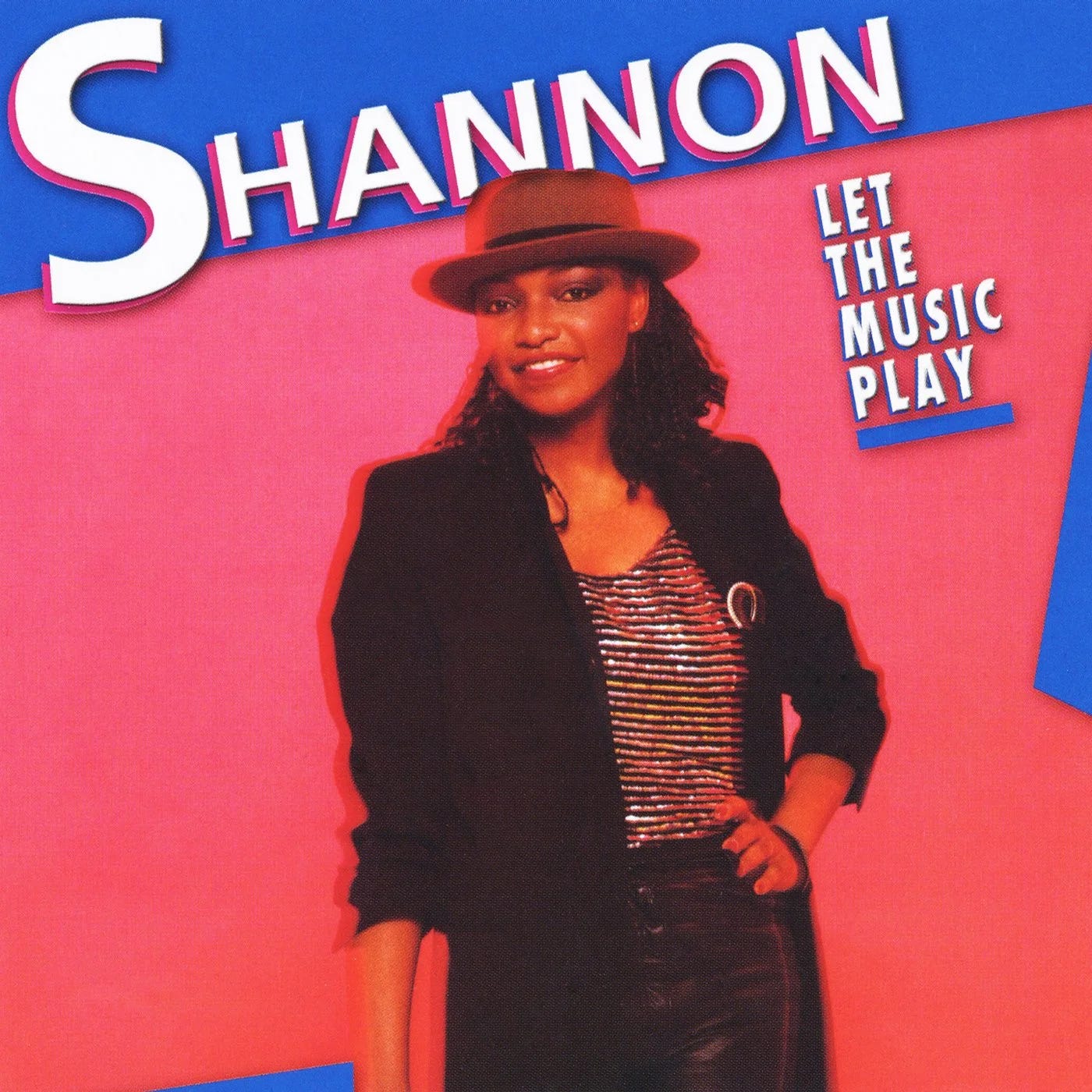
Generally considered the first freestyle song, the miraculous 1983 debut single by singer Shannon reached No. 1 on Billboard’s Dance Club Songs chart and snuck into the Top 10 of the all-genre Hot 100. Everyone has heard this song, and therefore everyone is familiar with the core sonic and lyrical hallmarks of freestyle.
“Let the Music Play” features eerie synth lines, a moody minor-key chord progression, thudding mechanized drums propelled by syncopated kicks, and lyrics and vocals that present romantic love as a matter of cosmic importance. Anyone who first experienced this song as a kid in the ’80s likely felt a mix of exhilaration, confusion, and perhaps a little fear. Why does the track open with the crack of a whip? What’s the strange voice on the chorus? Isn’t dance music supposed to be carefree and fun?
Electro Roots
When “Let the Music Play” dropped in 1983, it wouldn’t have sounded completely alien to its intended audience: young clubgoers in and around New York City. Dance music was going through a transitional phase, as disco was dying out and giving way to a host of other sounds now lumped under the umbrella of “post-disco.” There was hip-hop, most notably, but also its close cousin electro, or electro-funk, a sound that might accurately be called “breakdance music,” although it appealed to plenty of people who never learned to spin around on their heads.
The complex roots of electro stretch back across decades and borders. Black American funk pioneers like Stevie Wonder, George Clinton, and Sly Stone (RIP) began experimenting with drum machines in the ’70s. Stone famously used the primitive, non-programmable Maestro Rhythm King MRK–2 on his 1971 masterpiece There’s a Riot Goin’ On. Its gloriously dinky thump powers the smash “Family Affair.”
By the mid-’70s, the German man-bots of Kraftwerk had fashioned a cold, rigid, futuristic brand of electro-pop that would have a surprisingly massive influence on electro and hip-hop. Similarly, toward the end of the ’70s, sleek U.K. synth-poppers like Gary Numan and The Human League took advantage of newly affordable keyboards like the Roland System 100 and the Polymoog and proved you could make cool dance songs without virtuosic piano skills.
At the turn of the decade, Japanese art-pop innovators Yellow Magic Orchestra got their hands on the brand-new Roland TR-808 Rhythm Composer, which would become the defining drum machine of ’80s hip-hop. YMO’s BGM, from 1981, is among the first albums to feature the 808, and group member Ryuichi Sakamoto’s 1980 solo effort B-2 Unit includes the 808-powered single “Riot in Lagos,” which boasts the bumping feel of electro, albeit with artier flourishes.
Descended from all of this aforementioned music is the most important electro record of all time, 1983’s world-shaking “Planet Rock” by Afrika Bambaataa and Soulsonic Force. A Bronx hip-hop legend known for founding the “hip-hop awareness group” Universal Zulu Nation (and for allegedly doing a bunch of other things that have destroyed his legacy), Bambaataa was tuned into all of the synth-driven sci-fi sounds beaming in from around the globe.
“I was heavy into Kraftwerk, Yellow Magic Orchestra, Gary Numan,” Bambaataa told Austin Chronicle in 2015. “Take a pop sound from all those groups and add it to the funk sound of James, Sly, Bootsy, and Uncle George Clinton, and that became the birth of electro-funk.”
Bambaataa only deserves some of the credit for “Planet Rock.” In many ways, it was the brainchild of Arthur Baker, an industrious white dude from Boston who would become one of the era’s most important dance producers. Baker got his start DJing and producing disco records in Beantown and eventually made his way to New York City, where he met Tom Silverman, founder of Tommy Boy Records. Silverman hired Baker to produce “Jazzy Sensation,” Bambaataa and his group The Jazzy 5’s rap remake of Gwen McRae’s 1981 post-disco burner “Funky Sensation.”
“Jazzy Sensation” sold in the neighborhood of 50,000 copies, and as a result, Baker found himself back in the studio with Bambaataa and one of his other groups, Soulsonic Force, to record a follow-up. At the time, Baker liked to hang around a Brooklyn record shop called Music Factory, and one day, the store’s owners played him Kraftwerk’s “Numbers,” off 1981’s Computer World.
Baker loved the track’s semi-industrial groove, and he was equally fond of an earlier Kraftwerk jam, 1977’s “Trans-Europe Express,” which he’d hear echoing from local housing projects while working for a music distribution company out on Long Island. “Trans-Europe Express” has a shrill, icy melody worthy of a John Carpenter movie, and Baker and Bambaataa had the brilliant (if legally dubious) idea of combining that horror-show synth hook with the “Numbers” beat.
Sampling wasn’t yet a thing, so in order to recreate the “Numbers” beat in the studio, Baker had to use a drum machine. Nobody he knew had the desired TR-808, but he found an ad in The Village Voice that read, “Man with drum machine, $20 per session.” Miraculously, the guy wasn’t a psycho killer, and when they met up at the studio, Baker played him “Numbers” and asked him to program that pattern. The guy obliged, and because he insisted on being paid in cash, not by check, his name was lost to history. Baker thinks maybe it was Joe.
Co-producer John Robie played all the keyboard parts, Bambaataa and his crew provided the rapping, and Baker chipped in loads of winning ideas, like insisting on a proper chorus. They called the resulting song “Planet Rock,” and despite ripping off two Kraftwerk tunes, the record was completely original.
“We took bits of all the records that we liked,” Baker told Red Bull Academy in 2007. “In a way, it was sort of one of the first cut-and-paste records … I always said, when I was being interviewed then, that it was similar to jazz artists, taking bits, quoting things from other records, which I thought it was.”
Baker wanted this Afrofuturist street anthem to reach both Bronx b-boys and the Lower Manhattan punk kids who frequented clubs like Danceteria, and the song did exactly that. It’s a timeless artifact of the vibrant, graffiti-tagged, thrillingly multicultural NYC milieu that gave us Talking Heads, Madonna, Basquiat, Blondie’s “Rapture,” ESG, Keith Haring, and Kid Creole.
“Planet Rock” quickly went gold and influenced much of the electro that was to come. It also laid the rhythmic foundation for freestyle.
Fire and Ice
Like many forms of dance music, freestyle is a producer’s medium. It’s not that singers are inconsequential—they’re the ones who ultimately sell the song—but they’re generally not involved in the writing, and during the ’80s, few got the chance to escape the confines of the dance world and establish themselves as genuine pop stars. There was undoubtedly some degree of racism at play, as most of freestyle’s top artists were Latino or Black.
Shannon was not the driving creative force behind “Let the Music Play”—though she was hugely important to the finished product. There was a whole team responsible for the song, chief among them Chris Barbosa, a Bronx-born Puerto Rican American who got his start DJing on paddleball courts at neighborhood parks. Barbosa eventually started his own mobile DJ crew, The Mixologists, and that helped him score free promo records from labels.
Through the DJ scene, Barbosa met Sergio Cossa, head of the indie dance label Emergency Records. Cossa thought Barbosa and his fellow Mixologists member Nelson Cruz made a funny pair, so he signed them as a comedy duo. For some reason, Cossa later decided they should be rappers, and as Barbosa told Red Bull, they set out to record a song called “The Game of Life,” all about AIDS and various other issues plaguing the inner city.
The producer on “The Game of Life” (which seemingly never saw the light of day) was Mark Liggett, a Cincinnati native who knew a good thing when he heard it—and it wasn’t the song he was hired to record. During the session, Barbosa played Liggett “Fire and Ice,” an instrumental track he’d made at home using three pieces of gear—the Roland JX-3P, the Roland TB-303 Bass Line, and the MC-202—he’d purchased with help from his grandmother. It turns out Barbosa didn’t just want to spin records; he wanted to make them, too.
“I just started putting things together and programming,” Barbosa told Red Bull. “The difference was the syncopation that I was putting into the kick drums. I think that came from just growing up Puerto Rican banging sticks to Latin salsa music, plus always listening to pop music growing up in the ’70s.”
In the studio, Barbosa used gated reverb—a technique pioneered by Phil Collins—to get the kind of monster drums he heard on Afrikaa Bambaataa and Soulsonic Force’s “Looking for the Perfect Beat,” the follow-up to “Planet Rock,” also produced by Arthur Baker.
“Of course, when I heard ‘Let the Music Play,’ I went ‘God, I want drums like that,’ when they had, basically, taken the idea from one of my records,” Baker told Red Bull. “We were all listening to each other.”
The “fire” in Barbosa’s original title referred to the street-ready bass sound, while the “ice” was the pop melody. Liggett knew Barbosa had something special, and he suggested “Fire and Ice” was the song they should be working on. Liggett passed it to a friend to write lyrics, and he let another friend suggest a singer who might sound good on the track.
Her name was Shannon Brenda Greene, a Washington, D.C.-born singer who grew up in New York City in the ’60s. Shannon’s was a musical household; her Haitian father played guitar and sang gospel, while her mother—who was Black and Native American—sang and played piano. While living in Brooklyn and the Bronx, Shannon absorbed all kinds of music, including the salsa she heard all around her.
By the early ’80s, Shannon had begun taking care of her legally blind mother and working as a secretary and waitress, among other things. (According to various sources, she studied accounting at York College or New York University—her 2020 episode of the TV One series Unsung doesn’t specify which college she attended.) She also moonlighted with the New York Jazz Ensemble, and she was singing with that group when Liggett’s friend discovered her. Shannon was the first person to audition to sing on the record, and she killed it. The lyrics gave her plenty to sink her teeth into.
“Let the Music Play” is a drama featuring four characters: the narrator (a young woman), the man she falls in love with, an interloping second girl, and the personification of love, a Cupid figure who facilitates hookups not with arrows but with choice club jams. The setting is a strobe-lit nightspot. In the opening verse, Shannon describes how Love (it really should be capitalized) plays matchmaker.
We started dancing, and Love put us into a groove
As soon as we started to move
The music played while our bodies displayed through the dance
Then Love picked us out for romance
Things are going great until the song switches (maybe Love went to the bathroom or turned his attention to another couple), and the guy starts dancing with the other girl. Shannon is crestfallen. Here’s the pre-chorus, which summarizes all of the action up to this point.
We started dancing, and Love put us into a groove
But now he’s with somebody new
What does Love want me to do? Oh
Love said
That section ends with an implied colon. Everything in the chorus is sung from the perspective of Love, as voiced by Texas-born singer and guitarist Jimi Tunnell. Tunnell assures Shannon that everything will happen as it’s supposed to. She just has to trust the beat and keep on moving.
Let the music play
He won’t get away
Just keep the groove, and then
He’ll come back to you again (Let it play)
The second verse brings resolution. The guy realizes he’s fated to be with Shannon, and so he boogies his way back over to her section of the dance floor. Shannon is telling us what’s happening in the moment, which raises an interesting question: Are she and this fellow dancing to “Let the Music Play” by Shannon?
He tried pretending a dance is just a dance, but I see
He’s dancin’ his way back to me
The credited lyricist on “Let the Music Play” is Ed Chisholm, but according to Shannon, it was actually Ed’s sister Ann Godwin who came up with these immortal words. Shannon says Godwin was under contract to the publisher Jobete Music, and therefore she couldn’t put her name on it. If that’s true, it’s a shame, because she went way harder than she needed to. “Let the Music Play” is a song about love, but it’s also a song about the power of dance songs as good as this one.
“It had so many different types of elements that the world fell in love with it, especially the Latino market,” Shannon told Red Bull. “They were calling it the ‘Shannon Sound’ at the time, which became the Miami Sound, which became the South Florida Sound and, eventually, after you had so many artists coming out, they changed it to ‘freestyle.’”
In many respects, “Let the Music Play” is the quintessential freestyle song. It’s got those banging electro drums, spiced up with Latin percussion, and it follows a minor I-VI-VII chord progression, which would become standard for freestyle tunes. At 2:37, we get a spooky five-note riff that starts out ascending the minor scale but then jumps a perfect fifth. It must’ve caught everyone’s ear, because it’s in at least a dozen subsequent freestyle classics.
There are also some ways in which “Let the Music Play” is an outlier. First and foremost: Shannon can sing her ass off. There are other mega-talented vocalists in the freestyle universe—Lisa Lisa, Nayobe, Trinere, and Judy Torres come to mind—but some of the genre’s greatest songs are sung by people with rather imperfect voices. If freestyle is about one thing, it’s urban teenagers yearning for love and getting their hearts busted open like fire hydrants in July. Singers lacking in technical proficiency—like Cynthia and Johnny O, absolutely no shade—sound more authentic and believable. Freestyle is like punk rock in that way: The distance between performer and fan often feels negligible, and many of the producers who shaped the genre—Barbosa among them—had a strong DIY spirit.
Shannon never became Madonna or Janet Jackson. But she’s had a pretty impressive career. She followed “Let the Music Play” with “Give Me Tonight,” another ur-freestyle banger with Tunnell on the chorus. That single missed the pop Top 40, but it topped the dance charts, and Shannon’s debut album Let the Music Play, hit No. 32 on the Billboard 200 and went gold.
Shannon’s next album, 1985’s Do You Wanna Get Away, yielded a handful of minor hits, as the label pushed her further into pop territory. (It features a cover Foreigner’s “Urgent.”) Her third LP, 1986’s Love Goes All the Way, arrived amid personnel shakeups at Atlantic Records, and without the label’s backing, it flopped hard. As house and hip-hop took the place of freestyle, Shannon spent the next decade away from the spotlight. But in 1997, she returned to the top of dance charts with “It’s Over Love,” a cathartic house tune she recorded with producer Todd Terry for his album Todd Terry Presents Ready For a New Day.
Shannon claimed on Unsung that she hadn’t been paid royalties on her classic hits since 1984, and she filed a lawsuit to that effect in 2017. Fortunately, since freestyle nostalgia shows became a thing in the 2000s, Shannon has been in high demand, and on her official website, she bills herself as “the Queen of Dance, EDM & Freestyle.” Who are any of us to argue with that?
Barbosa died in October 2024, and his passing sadly elicited almost no media coverage. If his only contribution to music had been co-writing and co-producing “Let the Music Play,” he’d still be a genre pioneer deserving of a New York Times obit. But that was just the beginning of his career. He and Liggett formed a label, Ligosa Records, and gave the world a string of freestyle classics, including George Lamond’s “Bad of the Heart” and Monet’s Leave the Lights On, among the best front-to-back freestyle albums ever made.
Neither Chris Barbosa nor Shannon are household names, and plenty of people can’t name the genre of music they invented. But together, they made an all-time club anthem about how the right song can amplify feelings like nothing else can. And that’s what freestyle has always promised. It’s music for when you’re lost in emotion, dreaming of love, approaching that point of no return.
Thank you for reading! Watch out for the next installment—all about the queens of freestyle—in November.