

There are many legitimate contenders to the Queen of Freestyle throne. One can make solid cases for Lisa Lisa, Judy Torres, Trinere, Nayobe, and a host of others. If you care enough to argue passionately and in good faith, you really can’t be wrong.
Things are much simpler when it comes to naming a King of Freestyle. No shade on George Lamond or Johnny O—first-ballot hall-of-famers, both—but by virtually any metric, the honor belongs to Stevie B, the soft-voiced Miami auteur who did more than anyone to take the genre mainstream in the late ’80s and early ’90s.
Going purely by chart success, Stevie has no rivals. Between 1987 and 1995, the man born Steven Bernard Hill landed an astounding 11 singles on the Billboard Hot 100. Of those, seven made the Top 40, and one—the 1990 ballad “Because I Love You (The Postman Song)”—went all the way to No. 1, where it remained for four weeks.
Not all of those songs are freestyle. Not all of them are timeless. But many of them are great, and one of them might be the best freestyle song of all time. Stevie wrote and produced the bulk of his own material—something that sets him apart from just about everyone else in the genre—and he sang with a feather-light tone that (kinda) recalled Michael Jackson and (sorta) predicted The Weeknd.
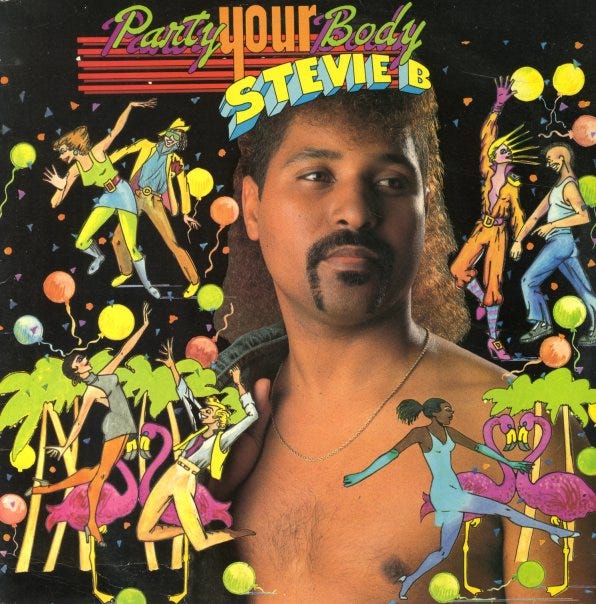
What’s more, peak-era Stevie B had a signature look, and that matters. Just as fans remember Lisa Lisa for that swoop of hair covering her eye, it’s impossible to think of Stevie B without seeing his trademark faux-hawk-mullet haircut, complete with lines shaved into the sides of his head and an accompanying horseshoe mustache. As music journalist Tom Breihan once pointed out on Stereogum, Stevie looked like “somebody’s sketchy uncle,” and yet in 1988, there were probably few dudes in Miami-Dade County getting more action than Stevie B.
And Stevie’s gone the distance. Not only is he a constant on the freestyle concert circuit, where he’s active in booking and promoting shows, but he’s continued releasing albums filled with new material, even if people aren’t exactly checking for new freestyle music. In 2023, around the time he launched the podcast Freestylin’ with Stevie B, he went hard to the hoop with “Take It All Back,” a blatant nostalgia play that manages to feel more sincere than it does cynical.
“Something happened in 1987, 1988, and 1989 that was so fucking special,” a 60-something Stevie said on the first episode of Freestylin’, responding to the notion that people should always move forward and discard their pasts. “You can’t just not look back at that like it never existed.”
Entrepreneurial Spirit
Stevie B was born April 19, 1958, in Fort Lauderdale. In interviews, he’s been cagey about his ethnic background, and in a 2014 chat with Music Connection, he promised to reveal his nationality in his autobiography, The Journey Of the Perfect Man, which arrived as an audiobook the following year but is seemingly no longer available in any format. Some sources claim he’s of Cuban descent, while others say Puerto Rican or Dominican. It’s not something he talks about in interviews, and that’s his business.
Growing up in the ’60s and ’70s, Stevie fell in love with all types of music and would sing in the bathroom like most other kids. By high school, he’d formed his first bands. “I always had this little yearning to be an artist,” he told Decades host Joe E. Kramer in 2020. “But you don’t know how you’re going to facilitate something like that.”
Young Stevie also played tennis, and he was handy enough with the racquet to earn a scholarship to college in Tallahassee, Fla. (He majored in business, but it’s unclear what school he attended. Perhaps it was Florida State, which is located in Tallahassee.) In 1989, while performing on The Mickey Mouse Club, of all shows, Stevie got a surprise visit from his mother. When asked what she thought her son would be when he grew up to be, she answered, “a tennis player.”
Stevie was entrepreneurial from a young age. While in Tallahassee, he opened a nightclub, and at some point, he sold custom T-shirts and started landscaping and car-stereo businesses. He didn’t forget about his musical aspirations, and in 1984, under the name Stevie, he released the single “Sending Out for Love” on his own Midtown label. Over live instrumentation—rubbery funk bass, disco guitars, pounding drums, searing synths, and some always-welcome vibraslap—Stevie sings way harder than he would on his later freestyle records. He’s a sweaty Casanova, and it’s evident he’s got something.
In 1985, Stevie formed a duo called Friday Friday with his buddy Warren Allen Brooks, and that same year, they released the single “Boy Toy,” a Cameo-style ’80s-funk workout with a decent hook. It was their one and only release, though they’d work together again—and achieve unexpected commercial success—years later.
Having learned how to engineer, Stevie used his savings to open up his own studio in 1986. “Once you learn how to engineer and produce, you don’t have to call on anybody,” Stevie told Decades. “You can just start developing your own music.”
He wasn’t ready to go it alone just yet, though. In 1987, Stevie produced a tune called “I Need You” for the Florida hip-hop trio BVSMP. Powered by Stevie’s silky-smooth chorus vocals, the track reached No. 3 on the U.K. charts. (The following year, Stevie would include a new version of “I Need You,” sans rapping, on his debut album, Party Your Body.)
Following the success of “I Need You,” Stevie devoted himself to making his own music. “I felt that I had a decent voice and wasn’t the ugliest guy in the world,” he told Fred Bronson for The Billboard Book Of Number One Hits. “So if I was packaged right as an artist, I could do all right.”
Enter Tolga
A fortuitous meeting in 1987 would help Stevie reach the next level. At a record pool—a gathering of DJs looking to obtain copies of the hottest new releases—Stevie struck up a conversation with guitarist, songwriter, and upstart producer Tolga Katas. Born in Istanbul in 1966, Katas fell in love with KISS when he was 12 and somehow wound up in South Florida, where he played guitar in area rock bands. It was fun, but local clubs only wanted cover bands, and Tolga wasn’t into doing other people’s music. So he struck out on his own.
Katas loved dance music as much as he dug rock, and he soon got his hands on all sorts of fancy studio gadgets, including the E-mu Emax sampler. “I was the second guy in Florida to have a digital sampler,” he bragged to Freestylemania in 2010. (He didn’t mention who was first.) “The tools gave me the edge!”
Armed with his Emax, Katas nabbed a gig doing mixes for the radio station Power 96, home of “Miami’s fresh new music.” There, he met top-rated DJ Bo Griffin, who was interested in making a record with her sister. Katas wrote and produced “Action Reaction,” credited to the group Griffin and released in 1987. While “Action Reaction” contains some freestyle elements, such as a syncopated kick drum, it feels more like synth-driven ’80s dance-pop than anything else. However it’s classified, “Action Reaction” suggests Katas knew what he was doing from a compositional and technical standpoint. He just needed the right partner.
That fateful day at the record pool, Katas was distributing copies of “Action Reaction” to influential DJs in hopes of promoting the record. He got to chatting with Stevie, who mentioned that he had his own studio in Fort Lauderdale. They exchanged numbers, and once Stevie heard “Action Reaction,” he wasted no time blowing up Tolga’s line.
“By the time I got home, there was a message on my answering machine, saying, ‘Ohh my god!! Where in the world did you get that snare sound? How did you make the kick drum sound so phat? Call me right away,’” Katas told Freestylemania. “I called him back; he was amazed by my sounds, and he had a mind blowing studio! It really was magical!”
In a 2023 interview with Get Out! magazine, Stevie said Tolga “changed the trajectory” of how he recorded. “He taught me how to do it electronically, when nobody else was doing it,” Stevie said. “He was doing stuff that was so amazing on the computer already. And all the analog boys thought it was just going to be a fad. I was like, ‘No, it’s not.’”
Stevie and Tolga got right down to business, and in 1987, they released the single “Party Your Body,” written by Stevie and engineered, programmed, and mixed by Tolga. On future releases, Stevie would play against his mulleted cool-guy image by singing with the utmost sensitivity and sincerity, but on “Party Your Body,” he’s alpha-male confident, promising, “I’ll freak your body / be your weekend fantasy.” In fairness, lines like, “Don’t you believe I can rock your body?” could be about his ability to make girls dance with his righteous freestyle music. It depends on how you define “rock.”
As Katas told Freestylemania, “Party Your Body” sold 35,000 copies within a few weeks, and Stevie landed a deal with the NYC-based Lefrak-Moelis Records, or LMR. Tolga and Stevie got to work on a full-length album, and in 1988, Stevie returned with Party Your Body, a collection of slick, catchy freestyle songs about poor Stevie’s endless quest for love. The song titles tell the story: “Baby I’m a Fool For Love,” “I Need You,” “No More Tears.” The LP’s second and third singles are absolute masterpieces of lovelorn melodrama.
“Dreamin’ Of Love,” a No. 80 hit on the Billboard Hot 100, comes hard with heavy drums, a storm-cloud melody, and the same creepy five-note synth lick found in Shannon’s “Let the Music Play.” Stevie is reeling after the dissolution of a “once in a lifetime” romance that we learn nothing about. At one point, he says he’ll “take the blame” for the breakup, though it’s unclear whether he’s owning up to mistakes or playing the martyr. Now he lives trapped between memories of the past and fantasies of a future reconciliation. For whatever reason, the music video is set in New York City.
I’m dreaming of love, thinking of you
Remembering times that we once shared
Dreaming of love, thinking of you
And knowing someday you’ll come back to my life
This same basic plot drives the album’s most enduring track, the exquisitely miserable “Spring Love,” one of the top five freestyle jams ever committed to tape. This time, Stevie gives us more information. He met a girl who was reeling from heartbreak, and he became her ideal boyfriend. They shared a season, and then they parted. For much of the song, we figure Stevie got dumped, but in the second verse, he sings, “But something changed, the season came to an end / I had to leave you, and that’s where my heartache began.”
Despite the fact that he ended it, Stevie spends the chorus pleading with his spring lover to come back to him. Maybe the regret is worse because it’s all his fault. In Fort Lauderdale, the land of frivolous spring break hookups, he found something real, and he blew it. In the “Spring Love” music video, Stevie cruises around Miami in a Pontiac Sunbird convertible with fuzzy snow leopard seat covers and reminisces about happier times on the beach with his ex.
Although it peaked at a disappointing No. 43 on the Billboard Hot 100, “Spring Love” became Stevie’s signature song. Years later, he revealed that he nearly gave it away to Cynthia Roundtree, the little-known Fort Lauderdale singer behind the 1985 freestyle delight “Stop Searching For Love.” Stevie evidently thought it could be a duet. Alas, Roundtree’s manager hated “Spring Love,” and Stevie lucked into keeping it.
In addition to being the ultimate distillation of Stevie’s singing and songwriting gifts, the achingly melodic “Spring Love” is emblematic of Miami freestyle on the whole and the ways in which it differs from the freestyle made in New York City around the same time. Although artists in both regions tended to use the same riffs and chord progressions, Florida freestyle reads as sunnier, and according to Stevie, that’s no accident.
“They used a lot of minor chords because they were coming out of New York,” Stevie told Enrique Santos for the radio show On the Move, commenting on the competition from up north. “If you want to know the weather in New York, listen to their music. If you want to know the weather in South Florida, listen to ‘Spring Love.’ I wrote music based on our culture.”
As beloved as “Spring Love” remains in freestyle circles, it didn’t exactly transcend the scene. You won’t find it on many lists of the best songs from the ’80s. It exists in its own little universe. Even at the time, Stevie felt slighted.
“We wound up selling a lot of records, but we didn’t get the critical acclaim from the big pop people,” he said in a 1988 video interview. “You figure, ‘How many records is it going to take for someone to say, ‘We have a real artist here with a real unique style?’”
“I Wanna Be the One”
Fresh off two Hot 100 hits, Stevie didn’t give the public a chance to forget about him. He was back in the mix with 1989’s In My Eyes, a sleeker, more sophisticated sophomore effort that only features Tolga’s mixing and engineering on three tracks. (Tolga landed his own deal with Cutting Records and dropped “Leave It All Behind,” the first of several excellent singles, in 1987.) Stevie wrote six of the eight tunes by himself and co-wrote the other two. He was fully in control of his formula.
The lead single and opening track, “I Wanna Be the One,” features a twinkly keyboard melody and hopeful lyrics about unrequited love. Stevie might not even know the girl he’s pining for (“I’ll get you looking at me somehow”), but he spends his nights dreaming of the day they’ll be together. This narrator arguably has it worse than the guy in “Spring Love,” and yet “I Wanna Be the One” is joyful in its yearning. Stevie filmed the video at the now-shuttered Plantation Fashion Mall in Plantation, Florida, a location that’s very ’80s and very freestyle.
“I Wanna Be the One” hit No. 32 on the Hot 100, making Stevie a genuine Top 40 artist. He’d fare nearly as well (No. 37) with the follow-up, “In My Eyes,” a weirdly intense little love song whose choral synth tones are vaguely similar to those found on Depeche Mode’s “Enjoy the Silence,” released the same year. Stevie’s scene-setting opening verse doesn’t make a whole lot of sense. One possible reading: He’s a guy who’s fallen head over heels very quickly, and he’s trying to assure his hesitant lady that his intentions are good.
You gotta believe there is something inside of me
You might say, “How could you so fast?”
Is the way you make me feel like you understand
There is a way I can meet your demand, girl ’cause
On the pre-chorus, which comes with a better hook than the actual chorus, Stevie comes off a bit like a vampire.
If you see the sun in my eyes
It should be as no surprise
It’s the light of love inside of me
Now tell me what do you see?
The “In My Eyes” music video was Stevie’s most artistic clip to date. There are black-and-white sequences featuring Stevie in his bedroom, looking pensive as the curtains billow. There are slow-motion shots of his girl riding a horse on the beach. There’s a lighthouse bathed in moonlight. The director really went for it.
The album’s third single, the treacly ballad “Love Me For Life,” cracked the Top 30 and hinted at what it would ultimately take for Stevie to reach pop’s promised land. “Love Me For Life” is bland Hallmark-card sentimentality set to junior-prom music, and it was yet another example of a freestyle artist scoring big with a schmaltzy ballad. (See also: Exposé’s “Seasons Change,” Sweet Sensation’s “If Wishes Came True,” and Timmy T’s “One More Try,” to name a few.)
The Postman Rings
For reasons he hasn’t discussed in interviews—perhaps because nobody has ever asked him about it—Stevie outsourced most of the songwriting on his third album, 1990’s Love & Emotion. Of the nine tracks, he penned only three by himself and co-wrote one other. The other five were the handiwork of Stevie’s old Friday Friday pal Warren Allen Brooks.
Three of the four singles were Brooks compositions, and two of those were massive. First, there was “Love and Emotion,” a cross between freestyle and one of the sounds pushing freestyle out of fashion, new jack swing. “Love and Emotion” is about a guy getting mixed signals from his girlfriend, and the massive major-key chorus puts the audience squarely on his side. “All I need is some love and emotion,” Stevie sings, eschewing all drama. “It’s the only thing that turns me on.” Talk about a wholesome kink.
It seems Stevie never made a “Love and Emotion” music video, but he did perform the song on The Arsenio Hall Show, and he absolutely murdered it. It turns out the multi-talented Stevie was also a very capable dancer. If he was able to harness half as much energy on the tennis court, he must’ve been a formidable opponent.
Which brings us to Stevie’s marquee moment. Way back in 1983, Brooks started writing what would become “Because I Love You (The Postman Song),” the second single off Love & Emotion. At the time, Brooks was a Miami music-biz hopeful struggling to get his career off the ground, and as he told Songfacts, he was “a little depressed.” He jotted down a verse, and it took him until 1989 to come up with a chorus.
On first listen, “Because I Love You (The Postman Song)” plays like another saccharine, Star Search-worthy love ballad. In the first verse, Stevie addresses some “you” who’s just sent him a letter. The letter writer is clearly in need of reassurance, so Stevie tells them (and us) that he’s composed this song as an answer, to prove his love is real. Why has he done this?
Because I love you
And I’ll do anything
I’ll give you my heart, my everything
Stevie doesn’t have the powerhouse voice typically needed to carry a song like this, but his little vocal flutters and quivers signal a level of sincerity that just about sees him through. Still, the most interesting thing about “Because I Love You (The Postman Song)” is the fact that Brooks was secretly doing his version of a gospel song.
“It’s a spiritual song,” Brooks told Songfacts. “It’s about me and God having a conversation, and God telling me that he got my letter and he’d be with me any time I needed him.”
That’s right: Stevie B sings from the POV of the almighty. He’s not serenading a lover; he’s comforting some down-and-out human who fears they’ve been forsaken. This religious subtext was almost certainly lost on the listening public. “Because I Love You (The Postman Song)” replaced Whitney Houston’s “I’m Your Baby Tonight” at the top of the Billboard Hot 100, and for four weeks, it kept Madonna’s kinky trip-hop banger “Justify My Love” from seizing the top slot.
Brazilian Salvation
Love and Emotion spun off one more hit single, “I’ll Be By Your Side,” another gooey ballad with nondescript lyrics. This one was a Stevie B original, and it went all the way to No. 12 on the Hot 100. It would be Stevie’s last Top 40 entry until 1994’s “Dream About You,” off Funky Melody. That album’s title seemingly refers to funk melody, a freestyle-influenced form of dance music native to Brazil, where Stevie moved in early ’90s after a period of personal and professional struggles.
“I was really going through hell,” Stevie told radio DJ Enrique Santos in 2025. “The record company stole probably a couple hundred million dollars from me. I was one of those artists that went through that thing they’re talking about … They took way advantage of me … These people don’t give a shit. They did it to you, and they just keep doing it to you. They did it to me, but I survived the apocalypse with them.”
Fortunately, on his very first night in Brazil, Stevie met the woman who would become his wife. They’re still together today, and Stevie learned to speak Portuguese. It’s no wonder he found new life in Brazil. In that country, freestyle never went away. The sound influenced a new generation of funk performers, most notably Anitta.
In America, Stevie says, freestyle is a “forgotten stepchild,” a genre that came out of nowhere and never enjoyed support from the music industry.
“Freestyle started with independent, no-name Puerto Ricans, Dominicans, and no-identity people,” Stevie told the magazine Get Out! in 2023. “It was a way that we could get into the music business very cheaply. It started amongst Puerto Ricans and Dominican people in New York and Miami. And it didn’t have very much money flowing with it, and then all of a sudden, it ‘went viral’—if that’s a word that I could use for that time.”
The way Stevie sees it, freestyle gained steam at teen clubs and skating rinks until it was big enough to contend with the day’s A-list pop stars and hair-metal bands on the radio. “We were interfering with people’s money,” Stevie said. “Major record companies and major independents had a lot of money invested in those [pop and metal] projects.”
So the majors signed up freestyle artists and, in Stevie’s estimation, neutralized the threat. At the same time, a bunch of “shitty freestyle started coming out,” according to Stevie, and to make matters worse, popular tastes changed. New jack swing, house, and most importantly hip-hop came to the fore. As the ’90s progressed, Black and brown artists could get played on TV and radio in a way they couldn’t just a few years earlier, when freestyle was popping.
“I was a little bit too dark for the pop radio stations,” Stevie said. “VH1, MTV, they wouldn’t play me. Even when I had the number one record on Billboard for four weeks in a row. They weren’t letting that in just yet. And then, all of a sudden, MTV and [Yo!] MTV Raps came. They started playing the Hammers, and then what happened was we weren’t Black enough. We weren’t hardcore enough. We were a little bit too soft. So, freestyle got put to sleep.”
A Special Rhythm
Regardless of industry trends, Stevie B kept going. He’s released at least 16 studio albums, including 2020’s Best of Life, his most recent. That album opens with the trap-pop title track before segueing into Afrobeats, R&B, and of course, freestyle. There’s also a cover of Kenny Rogers’ “Through the Years.” While not strictly a genre artist, Stevie never veers too far from his comfort zone.
In recent years, a handful of modern artists have shown Stevie love. Pitbull teamed up with the freestyle icon for 2013’s “Spring Love 2013,” an EDM update that falls well short of the original. Then in 2024, DJ Khaled sampled “Spring Love” on “Paradise,” featuring Fat Joe and Anitta. It’s much better than the Pitbull song.
As of this writing, Stevie remains a major presence on the freestyle nostalgia scene. And he still believes the genre has something to give. In 2019, he posted a 12-minute rant about how the next generation of artists was failing to push freestyle into the future (or even deliver listenable music).
“There’s a whole slew of records coming out right now by a group of people, and I can’t even fucking believe some of these records are coming out,” he said in the video. “Productions are horrible. Artists can’t fucking sing. Songs are mediocre at best. It is absolutely a fucking embarrassment to even be associated with a genre called freestyle.”
Stevie might’ve just been having a bad day. In interviews, he oscillates between self-aggrandizing (he often refers to himself in the third person) and humble, and on subjects ranging from nutrition to spirituality, he always has plenty to say. In 2010, when asked about being called the King of Freestyle, Stevie stopped short of saying the crown should be his.
“I look at it like this: If the people want to crown me to be a king, I’ll accept it,” he said. “But I don’t look at myself as being that. There’s a lot of artists out there who have better voices, better songs, but the public makes a decision on what they want. I’ll accept whatever they decide.”
Speaking with DJ and podcaster DjDOSync in 2023, a reflective Stevie thought back on mixing “Spring Love” with Tolga in 1988. They were a couple of nobody’s with big dreams, and yet they were locked in, like they knew something was going to happen. Stevie now believes they were blessed, and that they weren’t the only ones.
“This shit doesn’t come from us,” Stevie said. “It’s from God. Freestyle was made for us. There was no genre called freestyle or Latin dance … That door was created for us, those that are in it and that have been living in it as artists, producers, writers, DJs.
“This is a special language. It’s a special music. It’s a special tone. It’s a special rhythm. For the person that’s into hip-hop and all the other shit, you can’t even explain it to them, the meaning behind some of this stuff. It’s ours. It was created for us, for the people. God gave you to me and me to you, and we’ve been together ever since.”
excellent article .. En France on ne l'a connu que grace à "Because I love you" mais grace aux radios j'ai pu suivre un peu sa carriere freestyle à l'epoque. Attention , tu as cité 2 ou 3 fois Stevie Wonder au lieu de Stevie B :)