

Last week, we gave mad props to Nayobe. Here are two other ladies worthy of the Queen of Freestyle title.
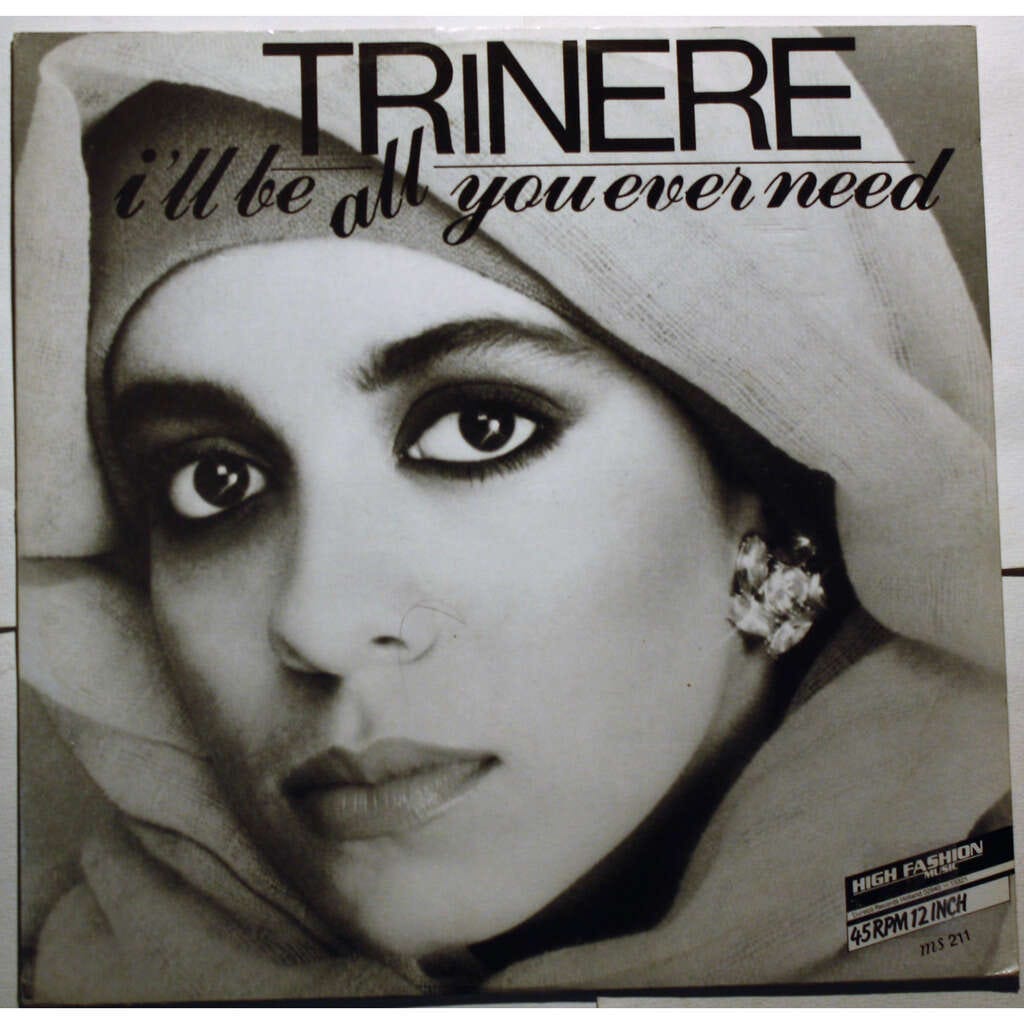
Trinere
Trinere is a South Florida native who’s perhaps the most overqualified freestyle artist of all time. She had the talent and training necessary to become a jazz or classical singer, but instead, she met “Pretty Tony” Butler, one of several individuals who might legitimately take credit for “inventing” freestyle. (Butler sits on this list with Arthur Baker and John Robie, the producers behind “Planet Rock,” as well as Chris Barbosa, architect of Shannon’s “Let the Music Play.”) Alongside Butler, Trinere recorded a string of early beat-forward freestyle tracks that emphasize the genre’s electro-funk roots. Over super-minimalist backing tracks, Trinere did heavy lifting with her voice and left behind at least five masterpieces.
As a little girl, Trinere Farrington studied piano, guitar, voice, and various types of dance. She was skilled enough to earn a scholarship to the University of Miami School of Music, where she majored in theater and jazz. Trinere’s mother was a classical singer, and Trinere dabbled in singing Italian arias and material of that stature. She could’ve made that her career, but while in college, she joined a Top 40 cover band called Euphoria and got her first taste of rocking Miami clubs. Her voice teachers were mortified, as modern pop music encouraged improper singing, but Trinere didn’t care. Then, she got an opportunity so golden she dropped out of school altogether.
Back when she was 15, she’d gone to see funk master Rick James, whose music she was obsessed with. Trinere managed to get backstage at the concert and grab the attention of percussionist Nate Hughes, who introduced her to James and the rest of the crew. Hughes stayed in touch—they’re still pals to this day—and when Trinere was 19 and going into her sophomore year of college, he told her there was a spot opening up in the Rick James offshoot group The Mary Jane Girls. Trinere left school and moved to Buffalo to audition, but the party atmosphere was a little too much for her, and she eventually returned home.
The night after she flew back to Miami, Trinere met “Pretty Tony” Butler, an innovator who, like Arthur Baker and Chris Barbosa, got his start as a DJ. As a high schooler, the Miami native spun Kraftwerk and Planet Patrol records at roller rinks and joined the Atlantic Records record pool. The label would send him new singles before they came out, and Butler would tell them which ones he thought were going to be hits. It turned out he was extremely good at this, and he decided to try making his own records.
When no local studios would give Butler a chance, he bought his own equipment and became a one-man operation, serving as talent scout, songwriter, producer, engineer, distributor, and promoter. Butler’s first attempt at creating a hit was “Summer Delight” by a band billed as—wait for it—Freestyle. (“Freestyle is what I came up with, and after that, it became a whole genre of music,” Butler told Miami New Times.) The record sold well, but working with other musicians proved difficult.
“People was going crazy over the record, and the guys in the group went crazy as well,” Butler told Red Bull. “They were turning into stars. I didn’t understand what was going on. The bass player was like, ‘I want to be louder.’ The drummer was like, ‘I want my drum part to be longer.‘ They was such a pain that I told them, ‘Go back to the garage and I’ll do it myself.’”
The industrious Butler got his hands on a vocoder, a Roland TR-808 drum machine, and a Roland Juno-60 keyboard. He used these gadgets to record “Jam the Box” and “Fix It In the Mix,” both released in 1983. Like “Planet Rock,” these are futuristic breakdance records with bumping bass and creepy minor-key synth hooks. Butler’s records have the added bonus of featuring cool sound effects like blipping laser beams and shattering glass.
Somewhere along the way, Butler also got into concert promotion, and one day, he popped into a local Peaches Records location to check the ticket sales for one of his upcoming shows. There, he met Deborah Wesoff-Lopez-Kowalski, a teen Peaches employee with a distinctive speaking voice and overall air of hipness. Butler thought Deb might be right for “When I Hear Music,” a new song he was toying with, and he invited her to his studio. Deb wound up singing that and “Lookout Weekend,” and both records—credited to Debbie Deb—became gigantic club hits and undisputed freestyle classics.
That’s another story for another day. When Trinere met Butler, she wasn’t familiar with his name, but she knew “When I Hear Music” and “Lookout Weekend.” They were huge records, after all, and according to Trinere, Butler had an equally large ego. They went back to his studio that first night, and Butler made a lousy first impression.
“He was judging me without hearing me,” Trinere told Nocturnal Transmissions. “He was like, ‘If you can sing, I want you to go in there and listen to this song and see what you can do with it.” The song was “I Know You Love Me,” another icy electro-thumper, and Trinere found plenty to do with it. In just one take, she laid down vocals that transformed Butler’s cold, skeletal bop into a song brimming with genuine emotion. Trinere plays the role of a woman whose would-be boyfriend is treating her like garbage for reasons she can’t understand. Her frustration boils over in a series of impressive high notes.
Trinere stayed the night, and the very next day, they made another song, appropriately titled “All Night.” (It became her first hit, since it was released before “I Know You Love Me.”) It’s textbook Butler, albeit with a melody and lyric reminiscent of “Let the Music Play.” Here, Trinere plays one half of a happy couple. Her dream guy calls her up at 6:15 and asks for a date. They spend the evening dancing and end by sitting in the rain, drinking champagne, and staring “into the night,” the most important three words in the freestyle universe.
Things were going so well that Trinere stayed at Butler’s for a week. “I had my girlfriend bring me clothes,” she told the podcast Old School Rewind. “And then my mother was upset. My mother was calling the police saying, ‘They kidnapped her—these drug dealers kidnapped her. She’s all the way in West Palm Beach.’”
Before long, Trinere and Tony became a couple, and they continued making music together. While Tony fielded offers from major labels, he opted to keep their operation independent.
“We wanted to do our own thing,” Trinere told The Slam Show. “We didn’t have to answer to [the majors]. They didn’t tell us when to do a record, or if we could do a record. We recorded anytime we wanted. If we wanted to do a record every day and put a record out every day or every week or every month, we could.”
That explains why Trinere has a slightly larger arsenal of bangers than most of her freestyle peers. In 1985, she released the rhythmically bruising “How Can We Be Wrong,” all about the disbelief that accompanies the implosion of a once-stable relationship. Butler has a field day with the effects, employing a super-deep synth-assisted voice to echo the word “Wrong!” and tons of breaking glass. It’s like Trinere is contemplating her romantic situation while smashing up a room full of champagne flutes.
Trinere says most of her big songs were written by Butler and his lyrical collaborators, Garfield Baker and Byron Smith, about Pretty Tony’s relationship with Trinere. So even if Trinere didn’t have any direct input on the songwriting process, she would’ve had no problem finding emotional footholds in the material.
In 1986, Trinere returned with the confident and sexy “I’ll Be All You Ever Need,” in which she rides a sturdy beat and stares down a confused, hesitant would-be lover, promising, “If you give me half a chance, I’ll rock your world.” The song builds to a killer high note that Tony coaxed out of Trinere in rather extreme fashion. As he told Red Bull, when Trinere was upset about something, she’d pretend she couldn’t hit notes that were definitely in her range. This happened during the recording of “I’ll Be All You Ever Need,” and Tony sent her home, only to phone her at 4:30 a.m. and call her back to the studio. When she got there, Tony says, she still fronted like that note was impossible.
“I kept a Mac-11 under my console,” Tony told Red Bull. “It’s the ’80s, everybody got to have a machine gun. I was so pissed that she was strong enough to continue to act. I took my gun and threw it and cracked the window of the vocal booth—you should hear how great she sounds. That was the version we used. Who takes a machine gun and breaks the vocal booth window and the girl starts singing wonderfully like a bird? People like the song.”
Trinere confirmed this absolutely wild story in her interview with Old School Rewind. “He was stupid back then,” she said. “Back then, in those days, we used to be very crazy. I think the recordings came out the best when we fought the hardest.”
Trinere’s 1986 self-titled debut album includes all of the aforementioned tracks, plus “They’re Playing Our Song,” which, like “I’ll Be All You Ever Need” and “How Can We Be Wrong,” cracked the Top 15 on the Billboard dance charts. Beginning in 1990, she released three more albums—1990’s Forever Yours, 1991’s Games, and 1992’s Trinere’s In the House—that saw her move beyond freestyle and try R&B and house. She and Butler eventually split up after having a son together, and in 1992, following a “very dark” period, Trinere walked away from music to devote herself to Christianity and raise her son away from the evils of showbiz.
She returned to music in 2005 at the behest of fellow Miami freestyle great Stevie B, and she’s been super busy on the scene ever since. She’s especially popular on the West Coast, where she’s now based, and in Brazil, where she’s among the freestyle artists who influenced a generation of “funk” or “funk melody” performers, including Anitta, now a global superstar.
Stevie B has called Trinere the “undisputed Queen of Freestyle” in Brazil, which is perhaps some consolation, since, in his estimation, she still doesn’t get her flowers from the cliquey New York City crowd. There’s some history of Big Apple freestyle musicians downplaying the contributions of the Sunshine State, as the accepted story is that NYC invented freestyle and Miami jumped on the bandwagon. But Trinere disputes this timeline.
“I don’t really feel they created it,” Trinere told Stevie B on his podcast. “How can you create something if something came before you? I came before a lot of those [New York] artists. So how did they create it? We started it and we made it in Miami first, and then the music traveled to New York and all of that.”
She’s less adamant when it comes to how she’s billed. “A lot of my fans say I’m the Queen of Freestyle,” she said. “And I’ll take that. I’m a queen anyway, of freestyle or whatever. I’m a queen, period. I am one of the pioneers of freestyle music out of Miami. I don’t really have a title title, but I can be all of those things.”
Judy Torres
Judy Torres might quibble with Trinere’s version of freestyle history. The Latina singer, actress, radio personality, and life coach believes the sound was “born and raised in the Bronx,” just like she was, and while reasonable people can and will disagree about what city gets to claim ownership of the genre, there’s no denying that Torres understands freestyle better than just about anyone. She knows how to sing it, as her all-timers “No Reason to Cry” and “Come Into My Arms” attest, and she knows why so many people—“freestyle freaks,” as she calls them—still care about the music 40 years later.
During her live shows, Torres frequently tells a short love story while performing a medley of freestyle classics. It’s a theatrical moment that beautifully illustrates the genre’s appeal.
“The reason we love freestyle so much is that it reminds us of a very dramatic telenovela,” Torres told a crowd in Chicago in 2022. She always starts the tale with a statement like that. Then she sets the scene: There’s a beautiful woman walking down the street, and Torres fittingly sings a snippet of Trinere’s confident and flirty “I’ll Be All You Ever Need.” Next, a man sees this woman and falls instantly in love with her. Torres launches into Johnny O’s “Fantasy Girl,” a song of lust and longing that might be the most freestyle freestyle song of all time.
The woman is excited, but she’s unsure of the man’s intentions. Torres segues into “Show Me” by The Cover Girls, which contains the chorus, “Show me, show me you really love me.” The man proceeds to show his love by seducing her—Torres soundtracks this with George Lamond’s pleading “Without You.” The woman takes the bait, and Torres returns to The Cover Girls for the giddy, love-drunk “Because of You.”
“They hook up to the only dirty freestyle song we have,” Torres told Chicago at this point in the story. She could only be talking about one tune: “Diamond Girl” by Nice & Wild, which actually contains the lyric, “You fit right on my finger / I’m so proud to have me in you.” At family-friendly events, like the recent Our Lady of Mount Carmel Feast in Williamsburg, Brooklyn, Torres refrains from singing that line.
“Everything is good for three days, and then he calls her at 3 o’clock in the morning—booty call time,” Torres told Chicago. “And she’s not a booty call, because she wants to be a priority, not an option.” The woman doesn’t pick up the phone, and that leads Torres to sing a bit of Coro’s “Where Are You Tonight?,” a song of suspicion and paranoia that exemplifies how the man is feeling. The woman responds with “Love Letter” by Giggles, and then they break up. Torres has just the song for this moment: Soavé’s “Crying Over You,” for obvious reasons. The saga ends with the woman going out with a drug dealer, the basic storyline of the TKA classic “Maria.”
The whole thing takes Torres a couple of minutes, and in that time, she offers far more than just a freestyle primer. Audiences get a sense of what brought her to music in the first place. Growing up in the Bronx, Torres listened to everything from The Beatles to country, but more than anything, she loved musicals. West Side Story and The Wizard of Oz were her favorites, and when she found out the girl who played Dorothy was named Judy in real life, it was the first time she liked her own name.
Music would have been a respite for Torres, who didn’t have the happiest of home lives. When she was seven, her mother left her abusive father, and Torres remembers being told to grab her favorite toy as they fled the house late at night. Years later, her mother remarried, but her stepdad was an alcoholic who would also get violent. Torres was afraid for much of her childhood, and she spent a lot of time crying.
Due to everything going on at home, she loved school, and by the time she got to Aquinas High School, the self-professed nerd had become an honor student. Because of her strong academics, the school pushed her into taking college-prep courses instead of art and music electives. But she sang in the choir and credits the ensemble’s director, Frank Roman, with teaching her much of what she knows about music.
His instruction was invaluable. Torres had decided at a young age that she wanted to be a singer, and she even found a voice teacher on Grand Concourse in the Bronx who agreed to a bargain rate of $10 per lesson. Unfortunately, her mother didn’t have even that much money to spare, so Torres resolved to learn her craft by listening to records and emulating her favorite artists. Her teachers became Barbra Streisand, Donna Summer, and weirdly enough, Dennis DeYoung of the prog-rock band Styx.
“Some of it is self-taught wrong,” Torres said of her singing style in an interview with The Bronx On. “Some of it is self-taught right.”
After high school, Torres hit the talent-show circuit and met manager George Vascones, who introduced her to his buddy Mickey Garcia, soon to become another monumental figure in freestyle history. An NYC native, Garcia got his start as a disco DJ in the ’70s, and by the ’80s, he’d graduated to doing on-air mixes for the popular hip-hop and R&B station 98.7 KISS FM.
Like Arthur Baker and Tony Butler before him, Garcia eventually made the jump to writing and producing records of his own, and his breakthrough came with “I Won’t Stop Loving You,” an A-1 freestyle joint released in 1986 and credited to C-Bank featuring Diamond Eyes. Ostensibly a group, C-Bank had been a project started by Arthur Baker associate John Robie in the early ’80s, and 1983’s proto-freestyle groover “One More Shot,” sung by Jenny Burton, was a Top 5 Billboard dance hit.
Torres passed Garcia’s audition, and the producer offered her a song called “Love’s Gonna Get You Tonight.” He also mentioned that he was working with two other singers, one of whom was named Vickie Ryan. The day before they were going to record, Torres and Ryan went to Garcia’s house and listened to each other’s songs. Torres wasn’t really feeling “Love’s Gonna Get You Tonight,” but she loved Ryan’s song, “No Reason to Cry,” written by Elvin Molina and Marilyn Rodriguez. As luck would have it, Ryan liked Torres’s song better, so they switched.
In Torres’ hands, “No Reason to Cry” is a song of romantic reassurance sung by a young woman who’d shed too many tears in real life. The beat on the original version, recorded in Garcia’s apartment with a crummy microphone, is thick and overpowering. Torres sounds like she’s standing five feet away from the mic and singing into a dense fog. The synths are sharp and piercing, and there’s an amateurish vitality to the record that must’ve translated to the dance floor.
“No Reason to Cry” blew up in the clubs even before Garcia nabbed a deal on Jackie Jack Records, a tiny label that went bust soon after the record dropped. Fortunately, during a performance at Club 1018 in Manhattan, Torres impressed an A&R woman from Profile Records, home of Run-DMC and Rob Base. The president of Profile wound up hating “No Reason to Cry,” but he agreed to sign Torres and the single on the condition they completely overhaul the track with new vocals and music. They did, and the sleeker, glossier “No Reason to Cry,” a far better showcase for Torres’s considerable vocal skills, reached No. 30 on the Billboard dance charts.
The success meant Torres could do a second Profile single, and one day, while she was in the car with Garcia, the producer played her a half-finished song called “Come Into My Arms.” It was intended for another artist, but Torres wanted the track for herself and offered to finish the lyrics. Inspired by a dude who ghosted her, she knocked out a third verse, continuing Garcia and co-writer Elvin Molina’s theme of trying to win back a lover who’s inexplicably ended things.
We, we can’t just let this die
You gotta give our love a try
Oh please be by my side
Don’t even begin to cry
’Cause I, I’m waiting to be with you
Just give me the chance to prove
That I’m the only one for you
You know I was the one
“Come Into My Arms” peaked at No. 19 on the Billboard dance charts. In 1989, Torres released her debut album, Love Story, the title track from which is another exuberant freestyle jam that became another dance hit. Now Torres was a genuine success story, and she’d made it on her own terms. Throughout her life, people had teased her about her weight, insisting nobody with her body shape would amount to anything in the music business. What’s more, industry execs urged her to change her last name to something more ethnically ambiguous. But she proved that a proudly curvy, openly Latina artist could be herself and still sell lots of records.
Torres returned with another album, the house-inflected My Soul, in 1992, but it didn’t yield any hits. She continued releasing singles for the next decade, and in 1997, she became the host of Freestyle Free For All on 103.5 WKTU in New York. The gig came about after she performed at a concert hosted by the radio station and impressed the program director with her ability to stall for time—freestyle, if you will—in between acts. The show earned big ratings and ran for more than a decade. When it ended, Torres stayed on at the station as a regular DJ.
In 2005, Torres unleashed her inner classic-rock fan and scored a Billboard dance hit with a cover of Journey’s “Faithfully.” Around that time, she was diagnosed with multiple sclerosis. She temporarily lost her eyesight, and for a while, she was very angry. Then an ex-boyfriend asked her, “Can you still sing?” When she answered “yes,” he told her to stop feeling sorry for herself, and that was the kick she needed to keep going.
In 2018, wanting to try something that scared her, she staged a one-woman show, aptly titled No Reason to Cry, at the Puerto Rican Traveling Theater on W. 47th Street in New York City. The performances sold out for four months, and in 2025, Torres joined the cast of Freestyle: A Love Story, a musical about two 50-something Latinos rekindling their teenage romance at a freestyle concert at Radio City Music Hall.
Torres still performs her hits, often at freestyle package concerts, and in interviews, she comes across as someone who’s been through hell and lived to see brighter days. Maybe that’s why she’s not into bickering about who deserves to be called the Queen of Freestyle, a title fans often throw her way.
“I never gave myself the title ‘the queen,’” she told Jambox Entertainment. “There’s a lot of chaos out there about who’s the queen. In this genre, in my opinion, there is more than enough room for all of us. Because every single person in freestyle contributed in their own way to the genre.”
Thank you for reading! Watch out for the next installment—all about the King of Freestyle—in December.
I can’t believe my luck: you published this article on Trinere and Freestyle a few weeks ago, which is when I resumed listening to my vinyl, which involved returning to old favourites, and which in turn drew me back to the freestyle hits I listened to in the early 2000s. That was when I lived in London and met someone who used to breakdance in the 1980s electro hip hop scene. He introduced me to various albums and compilations of that scene’s sound. And that’s how I encountered Trinere’s hits. I moved to Scotland around that time and never met anyone who was interested in freestyle. But I’ve been returning to it lately. I particularly enjoy the melodramatic romantic stories that often form the structure of the songs. They’re a kind of gothic sentiment, expressing feelings so deeply felt that you the listener feels the heartbreak keenly.
Excessively emotional songs that have an experimental technical texture or production appeal to me. I think freestyle music explores that strange contrast. Thank you for publishing what is a very interesting series!